Alfanar

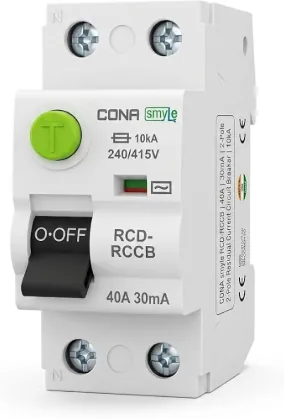
Residual Current Circuit Breaker, 2 Pole, 40A, 30mA

In Stock GULF MEP Ref.: ELE-0020 Unit: pcs MOQ: 1

Two-pole residual current protection device designed to detect residual current leakage. Rated at 40A with 30mA residual current sensitivity. Suitable for low-voltage installations

Availability

  • Riyadh · Saudi Arabia
  • Dubai · United Arab Emirates
  • Doha · Qatar
  • Kuwait City · Kuwait

Description

RCCB designed to disconnect an electrical circuit when residual current reaches the specified sensitivity level. Used as additional protection against electric shock and earth leakage

Applications

  • Residential
  • commercial and industrial distribution boards
  • socket circuits and electrical installations requiring residual-current protection

Specifications

Product type RCCB
Poles 2P
Rated current 40A
Residual current sensitivity 30mA
Mounting DIN rail

Available on request: Voltage, Frequency. Tell us the configuration you need and we will confirm these in writing: Get Quote

Choosing and specifying this item

Match the device to a circuit group, not the whole board

An RCCB is a switching and earth-leakage device only — it carries no overcurrent element, so the 40A figure describes what the contacts and terminals will carry continuously, not a level at which it will interrupt a fault. Back-up overcurrent protection has to sit upstream, and the conditional short-circuit rating in combination with that MCB or fuse is the figure to request with the enquiry.

Leakage budget decides how many circuits sit under it

At 30mA sensitivity the working margin is narrow. LED drivers, IT power supplies, inverter-fed equipment and long cable runs each contribute a standing leakage that accumulates across every circuit fed from one two-pole device. Clamp the existing installation before grouping circuits; where the load mix is heavily electronic, splitting across several devices or fitting per-circuit RCBOs is more dependable than one common unit.

Settle before ordering

Rated and insulation voltage against the site's single-phase supply — 220–240V across the GCC — and the declared frequency, since Saudi networks run at 60Hz while the rest of the Gulf is at 50Hz. Also fix the tripping type suited to the load waveform, whether operation is voltage-independent, and the module width for DIN rail planning.

Compare the rest of the range in Residual Current Circuit Breakers, Electrical. Related reading: RCDs and Earth Leakage Protection: What They Do and Do Not Do.

Frequently asked questions

Does this device protect the circuit against overload and short circuit?

No. A residual current circuit breaker senses only the imbalance between line and neutral. Overload and short-circuit protection must come from an MCB, MCCB or fuse in series with it, and that back-up device should be specified as part of the same package. Ask the supplier for the conditional short-circuit rating that applies when the two are combined, so the pair is properly coordinated.

How many final circuits can sit downstream of one 30mA device?

There is no fixed number — measured leakage decides it. Every electronic load adds a small standing current, and once the total approaches the non-operating threshold you get unexplained trips at random times of day. Clamp the installation, keep a comfortable margin, and where the mix includes variable speed drives, dimmers or large IT loads, break the load into groups or use individual RCBOs.

We are supplying a project in Riyadh — does supply frequency affect this selection?

It can. Saudi Arabia operates at 60Hz while the UAE, Qatar, Kuwait, Bahrain and Oman run at 50Hz, and the sensing circuit of a residual current device is specified for a declared frequency range. Frequency is not held in this catalogue entry, so request the manufacturer's declared value with the quotation and check it against the network the board will be connected to.

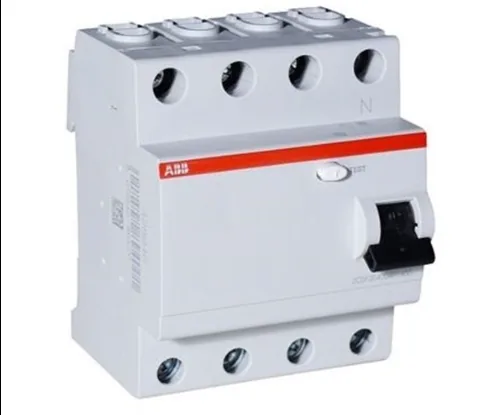
When should we choose this instead of a four-pole unit?

Pole count follows the supply rather than preference. Two poles switch line and neutral on a single-phase circuit; a three-phase board with a distributed neutral needs four poles so all live conductors and the neutral are broken together. Taking a two-pole device off one phase of a three-phase board is acceptable only when the group it feeds is genuinely single-phase throughout.

Related Products

More in Electrical

Related guides

Where we supply Electrical