

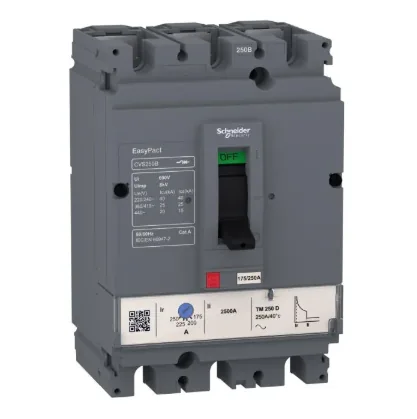
Moulded Case Circuit Breaker, 3 Pole, 100A
Three-pole moulded case circuit breaker for higher-current electrical protection. Designed for distribution and industrial power applications. Suitable for panel installation
Availability
- Riyadh · Saudi Arabia
- Dubai · United Arab Emirates
- Doha · Qatar
- Kuwait City · Kuwait
Description
MCCB designed for circuit protection in electrical distribution systems requiring higher current ratings than standard miniature circuit breakers
Applications
- Main distribution panels
- commercial buildings
- industrial installations and power distribution systems
Specifications
Available on request: Breaking capacity, Voltage, Trip unit, Mounting. Tell us the configuration you need and we will confirm these in writing: Get Quote
Choosing and specifying this item
Moulded case, or a large miniature device?
At 100 A the two device families overlap, so decide first what actually forces the moulded-case choice: a prospective fault level a miniature breaker cannot clear, the need for a lockable isolating point ahead of a sub-board, or a thermal setting that has to be tuned down to protect a cable smaller than the frame. That decision shapes the whole enquiry.
Confirm before requesting a quotation
Breaking capacity is the first gap to close — take the prospective short-circuit current from the upstream transformer rating and impedance, not from the feeder size. Rated voltage should be checked against 380-415 V three-phase distribution, with Saudi networks running at 60 Hz. Trip unit: ask whether the thermal element is fixed or adjustable and what band it covers, because a frame at this rating normally feeds a distribution board and has to grade against the miniature breakers below it. Mounting: fixed, plug-in or withdrawable, and whether the panel needs front, rear or extended terminals plus phase barriers.
Practical points
Three poles give no earth-fault protection by themselves; an earth-leakage relay with a core-balance CT is a separate line item. Allow for the temperature inside the enclosure, which in a Riyadh plant room sits well above any calibration ambient.
Other options in this family are listed under Moulded Case Circuit Breakers, Electrical. Further detail: Cable Sizing Basics: Why Ambient Temperature Changes Everything.
Frequently asked questions
Why use an MCCB at 100 A when miniature breakers are made at this rating too?
What do you need from me to quote this correctly?
Does a three-pole unit like this protect against earth leakage?
How do I make sure it grades with the MCBs it feeds?
Related Products
More in Electrical
- Electrical Wires & Cables
- Miniature Circuit Breakers
- Residual Current Circuit Breakers
- Distribution Boards & Electrical Panels
- Switches, Sockets & Wiring Accessories
- Building Wires & Cables
- Miniature Circuit Breakers — Additional Ratings
- Consumer Distribution Boards
- Metal Distribution Boards & Electrical Enclosures
- Switches & Sockets — Additional Products
- Multicore Copper Cables
- General
- Electrical Accessories & Control Equipment