

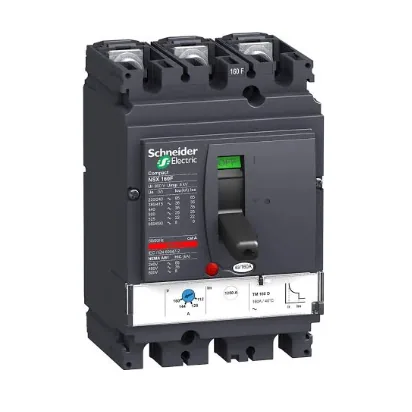
Moulded Case Circuit Breaker, 3 Pole, 160A
Three-pole MCCB designed for higher-current low-voltage power protection. 160A rated current. Suitable for electrical distribution panels and industrial installations
Availability
- Riyadh · Saudi Arabia
- Dubai · United Arab Emirates
- Doha · Qatar
- Kuwait City · Kuwait
Description
Robust moulded case circuit breaker designed for protection and isolation of electrical circuits in commercial and industrial power distribution systems
Applications
- Main distribution panels
- industrial electrical systems
- commercial facilities and power distribution
Specifications
Available on request: Breaking capacity, Voltage, Trip unit, Mounting. Tell us the configuration you need and we will confirm these in writing: Get Quote
Choosing and specifying this item
Where this frame usually lands
A 160 A three-pole device typically sits on a submain, a riser feeder, or the supply to a motor control panel serving pumps, air handling units or a packaged unit. Load character matters more than the headline current: on a motor feeder the magnetic, instantaneous element decides whether the breaker rides through starting current, while the thermal element protects the cable.
Gaps to close before quoting
Trip unit — establish thermal-magnetic or electronic, and whether the magnetic pickup is fixed or adjustable. For motor feeders, ask for that setting range expressed in multiples of rated current. Breaking capacity — a feeder this size is often one step from the incomer, so the fault level exceeds that at a final distribution board; take the figure from the network study. Voltage — confirm suitability for 380-415 V, and note Saudi Arabia runs at 60 Hz while other GCC networks are 50 Hz. Mounting — fixed or withdrawable, and the terminal arrangement.
Specify the accessories now
Auxiliary and alarm contacts, shunt trip and undervoltage release are ordered with the breaker, not fitted comfortably later. List them if the panel interfaces with fire alarm shutdown or BMS status monitoring. On a TPN board, decide how the neutral is carried, since three poles switch phases only.
See what else is available in Moulded Case Circuit Breakers, Electrical. See also: Earthing and Bonding: The Part Nobody Sees.
Frequently asked questions
Will a 160 A breaker hold in when a motor starts, or will it nuisance trip?
How does this differ in practice from the 100 A device in the same family?
Which accessories should be included with the order?
How is the neutral handled on a three-pole breaker in a TPN board?
Related Products
More in Electrical
- Electrical Wires & Cables
- Miniature Circuit Breakers
- Residual Current Circuit Breakers
- Distribution Boards & Electrical Panels
- Switches, Sockets & Wiring Accessories
- Building Wires & Cables
- Miniature Circuit Breakers — Additional Ratings
- Consumer Distribution Boards
- Metal Distribution Boards & Electrical Enclosures
- Switches & Sockets — Additional Products
- Multicore Copper Cables
- General
- Electrical Accessories & Control Equipment