

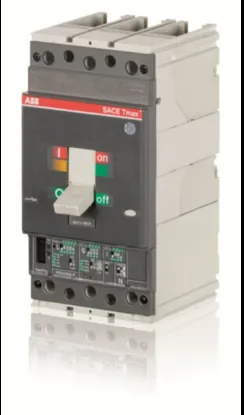
Moulded Case Circuit Breaker, 3 Pole, 250A
Three-pole 250A moulded case circuit breaker for high-current low-voltage power distribution. Designed for electrical panel applications. Suitable for commercial and industrial installations
Availability
- Riyadh · Saudi Arabia
- Dubai · United Arab Emirates
- Doha · Qatar
- Kuwait City · Kuwait
Description
High-current MCCB intended for circuit protection and isolation within low-voltage power distribution systems. Its moulded case construction is suitable for panel-based electrical systems
Applications
- Main distribution panels
- industrial facilities
- commercial buildings and power distribution systems
Specifications
Available on request: Breaking capacity, Voltage, Trip unit, Mounting. Tell us the configuration you need and we will confirm these in writing: Get Quote
Choosing and specifying this item
The fault level drives this selection
A 250 A three-pole device usually sits close to the transformer or inside the main low-voltage panel, where the prospective short-circuit current is at its highest. Get that figure from the transformer schedule or the utility, then settle two separate numbers with your supplier: the ultimate breaking capacity, and the service breaking capacity — the level after which the device is still expected to return to duty. Specifications that name only one of them tend to cause arguments at panel review.
Then the trip unit
At this frame size an electronic unit with adjustable long-time, short-time and instantaneous stages becomes the practical way to hold discrimination against the smaller feeders below. Confirm what is being offered, and whether any earth-fault stage is built in, since three poles provide none on their own.
Physical and thermal reality
Current at this level means large single conductors or two cables per phase, so confirm lug capacity, terminal spread, phase barriers and the bending space the panel must allow. Heat matters just as much: ask for the derating table against the enclosure's internal temperature, which in an unconditioned Gulf switchroom can be far above ambient, and fix the mounting method — fixed, plug-in or withdrawable — before the panel is drawn.
Compare the rest of the range in Moulded Case Circuit Breakers, Electrical. Related reading: Distribution Boards: Specifying for the Environment, Not Just the Load.
Frequently asked questions
What is the difference between ultimate and service breaking capacity, and which should I specify?
Can a 250 A device be set down to protect a smaller feeder?
What termination details do you need before quoting?
Does the rating need derating in a hot switchroom?
Related Products
More in Electrical
- Electrical Wires & Cables
- Miniature Circuit Breakers
- Residual Current Circuit Breakers
- Distribution Boards & Electrical Panels
- Switches, Sockets & Wiring Accessories
- Building Wires & Cables
- Miniature Circuit Breakers — Additional Ratings
- Consumer Distribution Boards
- Metal Distribution Boards & Electrical Enclosures
- Switches & Sockets — Additional Products
- Multicore Copper Cables
- General
- Electrical Accessories & Control Equipment